
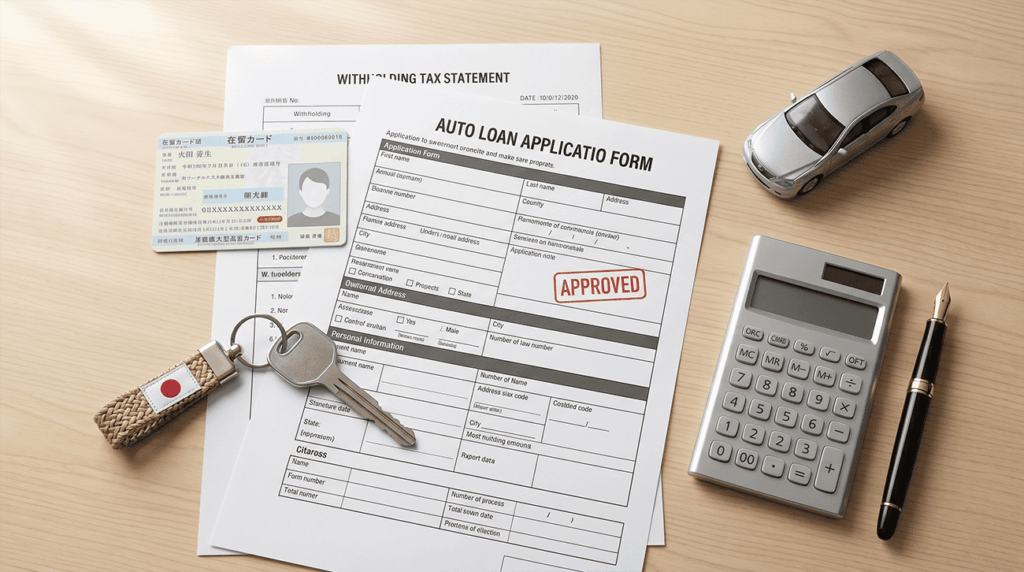
“I’ve been in Japan for five years, and I’d really like a car — but every time I try to research it, the information is scattered across a dozen sites and I have no idea where to start.” We hear this almost every week.
Things Japanese buyers never have to think about can pile up quickly for foreign residents: visa status, loan approval, license conversion, personal seals, what to do with the car when you eventually leave Japan. Each piece sits with a different agency or industry, and the information rarely connects.
This page gathers all of it into one comprehensive guide. Topics that need a deeper dive link out to dedicated articles, so you can branch off based on your situation.
Five Walls Foreign Residents Face
Compared with Japanese buyers, foreign residents typically run into these five additional challenges:
| Wall | Difficulty | Main Issue |
|---|---|---|
| ① Visa status | ★★ | Short-stay visas can’t buy; visa stability shapes loan eligibility |
| ② Required documents | ★ | Residence Card, Juminhyo, personal seal, signature certificate |
| ③ Auto loan approval | ★★★★ | Permanent residency vs. not changes the picture dramatically |
| ④ Driver’s license | ★★ | International permit works for one year; conversion required after that |
| ⑤ Voluntary insurance | ★★ | No-claim history starts at zero; multilingual support is limited |
This guide walks each wall in order, then closes with sections on returning home, corporate purchases, and Soukyo’s foreign-buyer support.
Wall 1: Visa Status — Who Can Buy, Who Has to Work for It
Bottom line: any visa that allows resident registration also allows you to buy a car. But “buying” and “getting a loan” are different problems, and the gap between them is where most issues arise.
| Visa Status | Buy? | Loan Approval Outlook |
|---|---|---|
| Permanent / Special Permanent / Naturalized | Yes | Roughly equivalent to Japanese applicants |
| Spouse of Japanese / Permanent Resident | Yes | Roughly equivalent |
| Highly Skilled Professional / Business Manager | Yes | Often approved with sufficient income and tenure |
| Engineer / Specialist in Humanities / International Services | Yes | Realistic with 3+ years tenure and 4M+ yen income |
| Specified Skilled Worker / Technical Intern | Yes | Tough; co-signer almost always required |
| Student / Dependent (adult) | Yes | Solo applicant rarely approved; co-signer needed |
| Short-Stay (tourist, etc.) | No | No resident registration -> can’t get parking certificate |
“Purchasing” and “loan approval” are completely separate questions. Pay in cash and visa status barely matters; documents alone are enough.
Wall 2: Required Documents
The unique pain point for foreign residents is that documents Japanese citizens have automatically often need to be produced from scratch.
Essentials
- Residence Card (front and back copies): the cornerstone ID. Watch the expiration date.
- Juminhyo (certificate of residence): obtained at your ward/city office; valid within the last three months.
- Registered seal certificate (Inkan Toroku) or signature certificate: required for standard vehicle registration. Foreign residents can register a personal seal using romaji, kanji, or katakana (depending on the municipality). If you’d rather avoid a seal, an embassy-issued signature certificate can substitute.
- Parking certificate (Shako Shoumei): issued by the police station with jurisdiction over your registered address. See “Buying a Car in Japan: A Practical Guide to the Shako Shoumei for Beginners and Foreign Residents” for details.
Keep Your Romaji Spelling Consistent
This is the quietest deal-breaker. If your Residence Card reads “ZHANG SAN”, every other document — contract, vehicle registration, insurance — needs to read “ZHANG SAN” too. Mixing in kanji or alternate spellings causes friction at title transfer or resale.
Wall 3: Auto Loan Approval — The Biggest Hurdle
If you can pay cash, you can skip this section. Otherwise, this is the steepest part of the climb.
Auto loan reviews for foreign applicants weigh three factors: income, tenure, and visa stability. Approval is harder than for Japanese applicants, but with the right preparation, even applicants without permanent residency frequently pass.
Key takeaways:
- Permanent residency helps but is not decisive.
- Three years tenure and 4M yen annual income is the typical threshold.
- A co-signer materially raises approval rates.
- Approval rates vary widely between lenders — choose carefully.
→ For the deep dive, see “Auto Loans for Foreign Residents in Japan: Approval Rates by Visa Status and 5 Ways to Get Approved Without a Guarantor”.
Wall 4: Driver’s License — IDP or Foreign License Conversion
Within One Year of Arrival: International Driving Permit
An IDP from a Geneva Convention country (US, UK, France, Germany, South Korea, Thailand, Philippines, etc.) is valid in Japan for one year from your date of entry. The “leave for 90 days and re-enter” loophole has been closed.
Beyond One Year: Foreign License Conversion (Gaimen Kirikae)
You’ll need to convert your home-country license into a Japanese one. Difficulty varies by country:
- Test-exempt countries (no written or practical exam): Germany, France, Switzerland, Taiwan, South Korea, etc. — vision check and paperwork only.
- Test-required countries: China, Vietnam, Philippines, India, Nepal, etc. — written and practical exams.
For test-required countries, three to five practical-exam attempts is common. Pass rates land in the 20-40% range. Driving schools that offer foreign-license conversion prep significantly improve your odds of passing on the first try.
Note for Holders of Chinese Licenses
China is not party to the IDP system, which means foreign-license conversion is required from the moment you arrive if you want to drive. Bring the original license with the issuance date and a Japanese translation; obtaining a driving-history certificate before leaving China is strongly recommended.
Wall 5: Voluntary Insurance — High Premiums in Year One
Japanese auto insurance uses a “no-claim bonus” system: longer accident-free histories yield lower premiums. The catch is that foreign residents start at level 6, paying more in their first year.
Foreign No-Claim History Can Sometimes Transfer
Some countries and regions — South Korea, Taiwan, Hong Kong, and a few others — allow you to transfer your existing no-claim record (up to level 20) by submitting a Letter of No Claim from your home insurer. Zurich, Sony Sompo, and Mitsui Sumitomo are among the providers that accept this. Securing the document before relocating can cut first-year premiums by half or more.
Multilingual-Friendly Insurers
- Zurich: strong English call center support.
- Sony Sompo: English support available.
- SBI Sompo: usually the lowest premiums.
- Aioi Nissay: well-regarded for accident handling.
Chinese-language support remains limited; many of our customers prefer to let a multilingual dealer handle the insurance arrangement on their behalf.
Bonus: Parking Certificate and Shinagawa Plates
For two of the most foreign-resident-relevant document topics — the parking certificate (most likely to trip people up) and the Shinagawa plate (Tokyo’s most-coveted regional name) — we have separate deep dives:
- Buying a Car in Japan: A Practical Guide to the Shako Shoumei for Beginners and Foreign Residents
- How to Get a “Shinagawa” Plate: Tokyo’s Most Coveted License Plate, Explained
Bonus: Corporate Purchase as a Tax Strategy (Business Manager Visa)
If you hold a Business Manager visa or operate as a sole proprietor, registering a vehicle under your company offers several advantages:
- Depreciation reduces corporate tax (six-year schedule for standard vehicles; shortened useful life applies to used cars).
- Fuel, parking, and insurance costs become deductible business expenses.
- In some cases, corporate loans are easier to secure than personal ones, even without a co-signer.
The tax authorities will look closely at private-versus-business apportionment and operational substance, so consult a tax accountant. At the vehicle-selection stage, picking models that are easy to justify as business use (minivans, SUVs, commercial vehicles) simplifies later defense.
Bonus: Disposing of Your Car When Returning Home
Every year, a steady stream of departing residents leaves an unresolved car behind in Japan. Before flying out, settle one of the following:
| Method | Time | Loan Settlement | Best For |
|---|---|---|---|
| ① Sell to a used-car dealer | 2-7 days | Sale proceeds offset loan balance | Optimal in most cases |
| ② Temporary deregistration | 1 day | Loan balance settled separately | Plan to sell or export later |
| ③ Permanent deregistration (scrap) | 1-3 days | Same as above | Older or accident-history vehicles that won’t sell |
| ④ Export overseas | 2-4 weeks | Export certificate + deregistration | Bringing the car home |
Important: a vehicle with an outstanding loan is technically owned by the finance company, so unilateral sale or scrapping is prohibited. Always contact the lender first and either offset the loan with sale proceeds or pay it off before disposal.
Soukyo’s Support for Foreign Buyers
Our shop in Yashio, Saitama provides the following services for foreign-resident customers:
- Multilingual support: Chinese and English consultations (in person, LINE, email).
- Lender relationships: connections with finance companies known for higher approval rates for foreign applicants.
- Document handling: end-to-end coverage of parking certificate, title transfer, and seal registration logistics.
- Repatriation support: from urgent-departure scenarios, sale and deregistration completed within days.
- Export support: for customers who want to bring their car home.
Find a Used Car
Over 100 hand-picked quality vehicles in stock. Every car comes with warranty and pre-delivery inspection.
Conclusion — Get the Order Right, and It’s Doable
Buying a car as a foreign resident in Japan means working four parallel tracks: documents, loans, license, insurance. Compared with Japanese buyers, the path is more complex. But with the right sequence, you can buy a car — with or without permanent residency, with or without a co-signer.
Use this guide to map the territory, then dive into the specialist articles wherever your bottleneck lives. If you’re stuck, our free consultation (Japanese, Chinese, or English) is always open.
Frequently Asked Questions
Q. Do I need permanent residency to buy a car?
A. Not for cash purchases. Any visa that allows resident registration is enough. Permanent residency only matters when you finance through a loan, where it raises approval rates.
Q. Can students buy a car?
A. Adult students can purchase. However, loans solely in a student’s name almost never pass review, so cash purchases or having a parent serve as co-signer are the realistic options.
Q. Can I drive in Japan with a Chinese license?
A. China is outside the IDP framework, so you must complete a foreign-license conversion to drive in Japan. Both written and practical exams are required, and multiple practical attempts are common.
Q. What if I leave Japan with an outstanding car loan?
A. The finance company is the legal owner until the loan is paid off. Always contact the lender before departure, and either offset with sale proceeds or pay off the balance before disposing of the car.
Q. Does buying through a corporation help approval for foreign applicants?
A. With a Business Manager visa and an established Japanese company, corporate loans are mainly evaluated on company financials, so the representative’s visa status is no longer the deciding factor. Most lenders, however, want to see at least two completed fiscal years.
Contact Us
Buying, selling, inspections, rentals — whatever your question, we're happy to help.